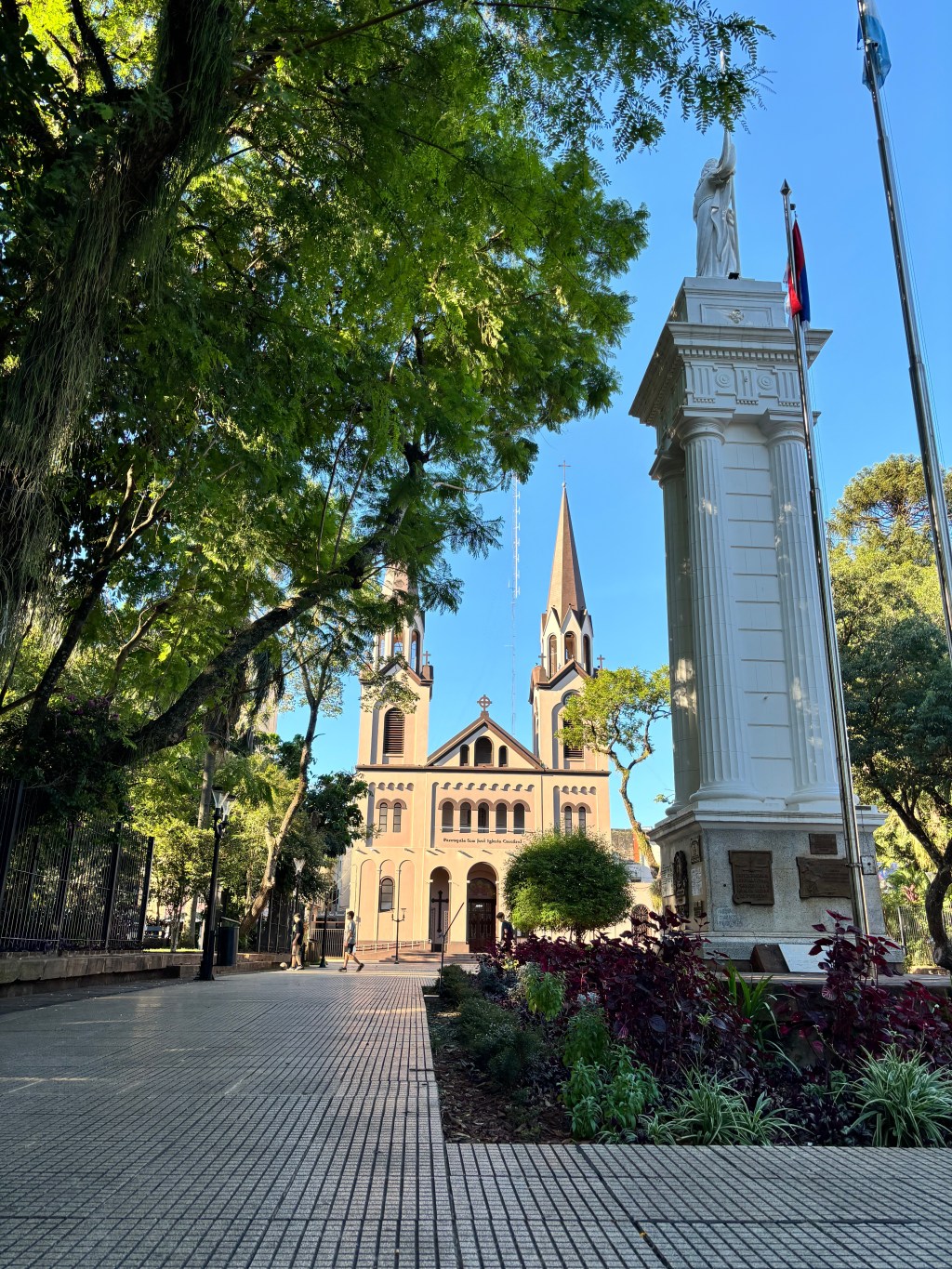
At the center of Posadas lies Plaza 9 de Julio, the city’s main square and one of its most emblematic spaces. Named after Argentina’s Independence Day, it has been the backdrop for more than 150 years of history, politics, celebrations, and daily life.
Origins and Early Years (1870–1910)
The story of the plaza begins in 1871, when the surveyor Francisco Lezcano laid out the first urban plan for a city that was then called Trinchera de San José.
Four blocks were set aside for plazas. Over time, two of them disappeared into other uses, and today only Plaza 9 de Julio and Plaza San Martín remain.
Plaza 9 de Julio occupies the highest point in the city of Posadas, a natural choice for its civic center. From the very beginning, this elevated ground was destined to become the symbolic heart of the city. In its earliest years, the site even served as the town’s cemetery, until the remains were moved in 1873. Soon after, the city began transforming the space into a square. In 1881 the first fencing and ornamentation were added, in 1883 eighty orange trees were planted, and by 1902 the plaza already glowed with electric lighting, a symbol of modernity in a young and growing town.
The Liberty Monument
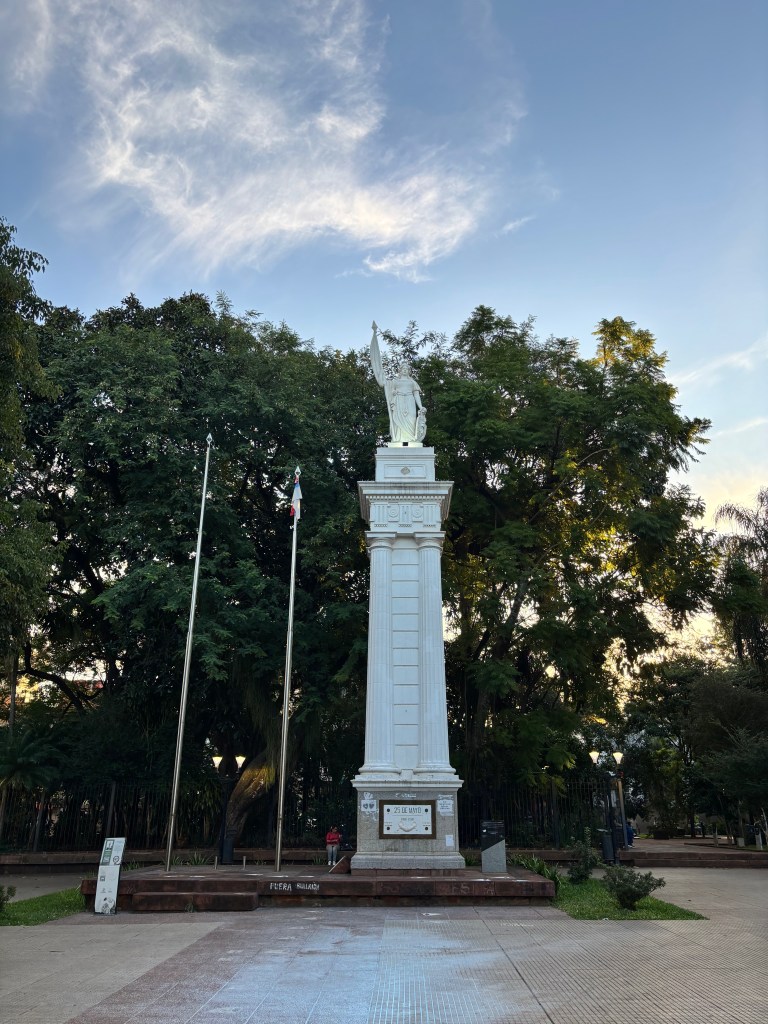
The most important symbol of the square arrived in 1910, when, on the centenary of Argentina’s May Revolution, the Monumento a la Libertad was inaugurated. Sculpted by the French artist Messier Bertheme, it originally faced the Cathedral.
In the great remodeling of 1937, the architect Alejandro Bustillo reoriented it toward the Casa de Gobierno, highlighting the civic character of the plaza.
Transformations of the Civic Heart
Over the decades, Plaza 9 de Julio has been reshaped again and again. Bustillo’s 1937 plan gave it diagonals and redesigned its gardens. In the 1960s, local architects Jorge Pomar and Carlos Morales, inspired by modernist ideas, reshaped the square into the more open form we know today, one that could host parades, demonstrations, and open-air religious ceremonies.
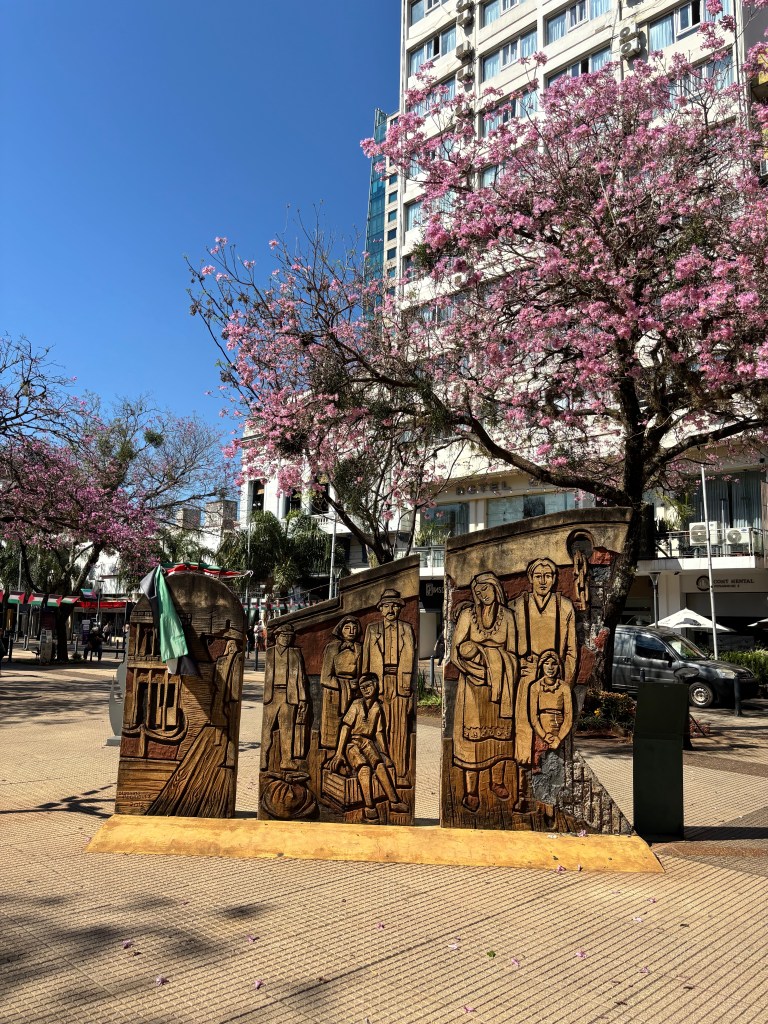
During this period, the plaza took on a new symbolic dimension with the addition of monuments that reflected the values and identity of Misiones. In 1960, the Lions Club donated the statue A la Madre, a heartfelt tribute to mothers and children of the province. In later years, monuments honoring the immigrant communities that helped build Posadas were installed, turning the square into a space that celebrates both family and the diverse cultural roots of the city.
Controversies and Discoveries
The square’s history is also marked by disputes and surprises. In 1909, Governor Justino Solari ordered the felling of all its trees and sent the timber to Corrientes, an act that sparked indignation among the townspeople. In 1998, workers digging for underground cabling uncovered human remains and Guaraní/Jesuit artifacts, evidence of the plaza’s past as a cemetery.
In 2020–21, the municipality added new fences around parts of the plaza, officially to protect its vegetation. Many architects and activists, however, criticized the measure as restrictive, pointing out that a public square should remain fully open to the people. The debate reflected the deeper symbolism of the plaza as the city’s most visible civic space.
Where the Rainforest Meets the City
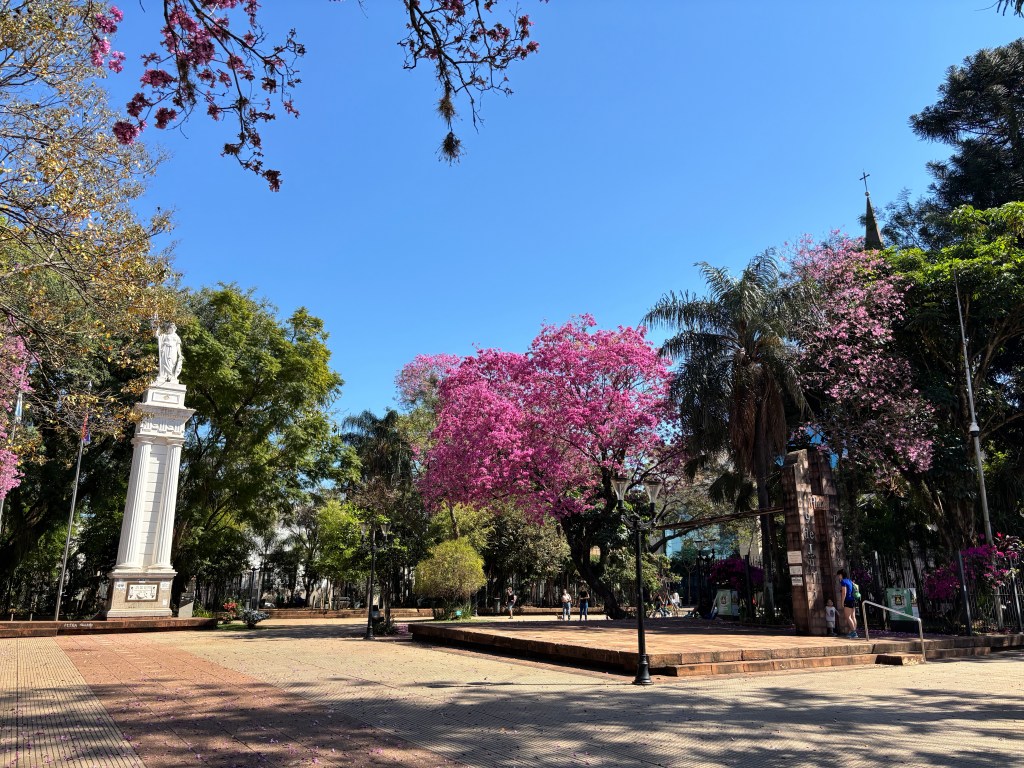
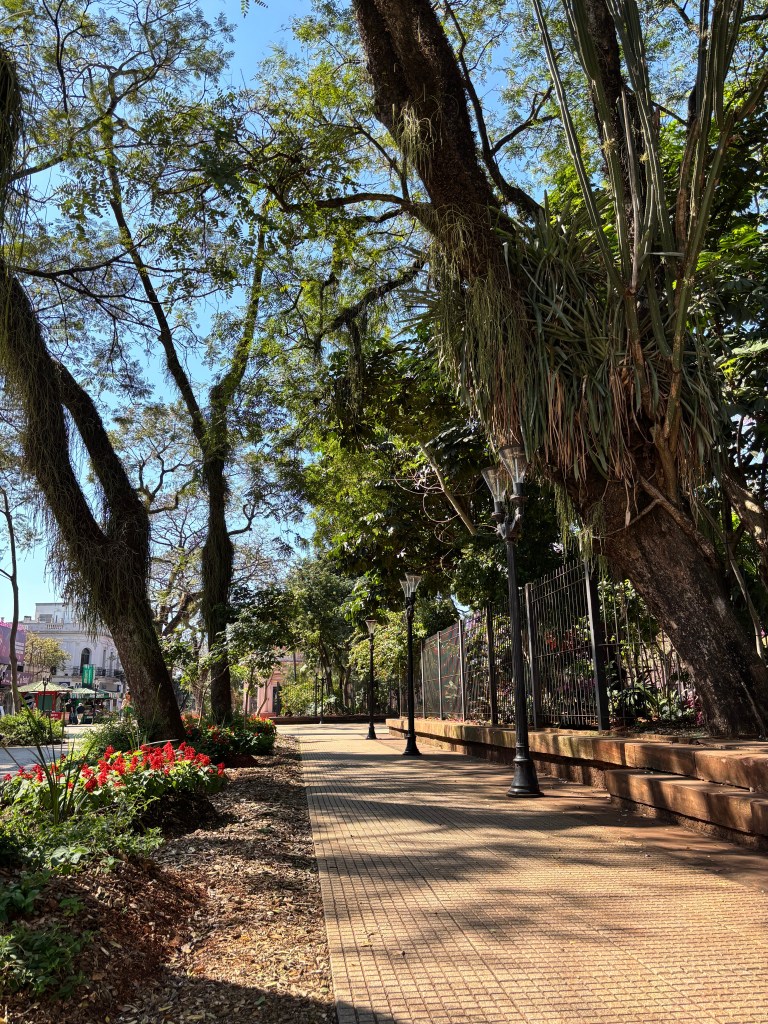
Despite being the civic heart of the city, Plaza 9 de Julio is also a green oasis. Its vegetation was designed to echo the subtropical rainforest of Misiones, with large flowerbeds and tall trees providing shade and color. Among the most emblematic species are the lapacho, whose pink blossoms are the provincial flower, the purple-flowering jacarandá, and the towering araucaria. Some trunks are even home to orchids and other epiphytes, adding to the sense of a living forest. Together, these elements create a miniature portrait of the jungle that covers much of the region, reminding visitors that even in the city center, the Misiones’ forest is never far away.
Today’s Plaza
Today, Plaza 9 de Julio remains the stage for public life in Posadas. It is framed by two of the most important institutions of Misiones: the Casa de Gobierno and the Catedral de San José. Here, the city gathers for Independence Day parades, political rallies, and open-air masses, making the square both a civic arena and a place of community.
At the same time, it is part of everyday life: flower stalls brighten its sidewalks, vendors sell warm chipa, cafés spill out onto the surrounding streets, and friends share tereré in the shade of its trees. This blend of civic symbolism and daily rhythm is what makes Plaza 9 de Julio the true heart of Posadas.
Surrounding Landmarks
Plaza 9 de Julio is not only the main square of Posadas. It is also framed by some of the city’s most important buildings, each adding to its character:
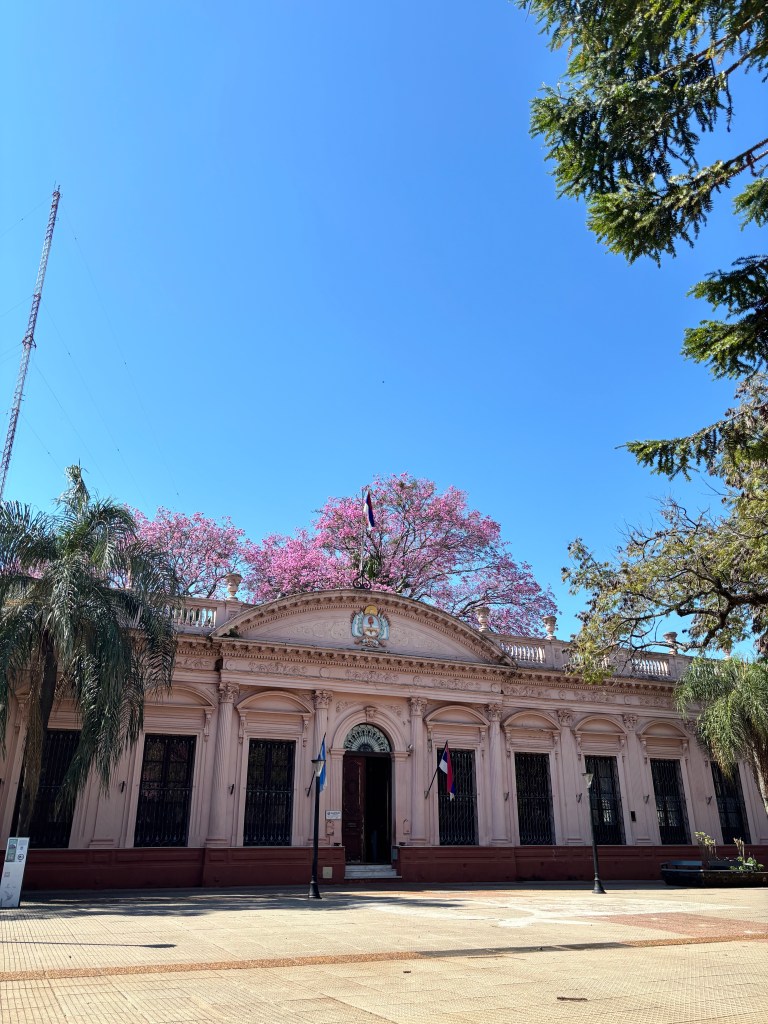
Casa de Gobierno (Government House): Built between 1882 and 1883 on Félix de Azara Street, originally as a private residence, it later became the seat of the provincial government. Its classical style stands out, with Corinthian columns, ornate details, and a grand wooden entrance.
Catedral de San José (Cathedral of St. Joseph): Facing the plaza on San Martín Street, the Cathedral has been central to Posadas since the 19th century. The current building, finished in 1937, combines neo-Gothic towers with Romanesque windows and simple interior decoration.
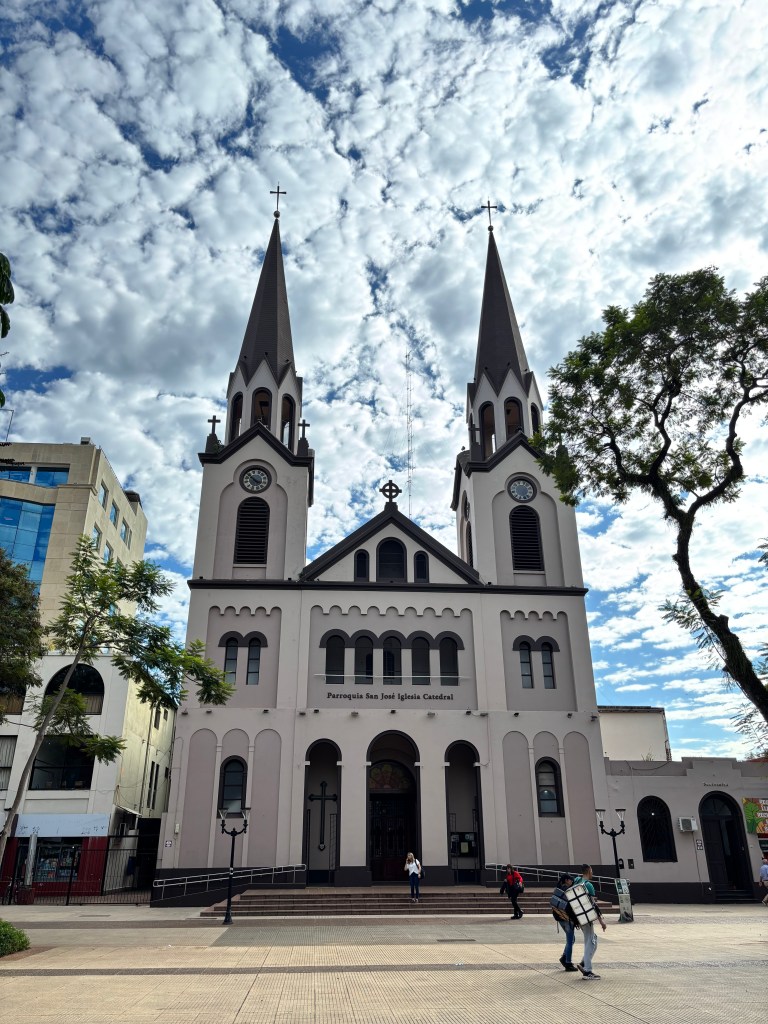
Inside, visitors find images of Our Lady of Itatí and Saint Joseph, as well as an impressive German organ brought in 1963.

Sociedad Italiana de Socorros Mutuos (Italian Mutual Aid Society): Located on Bolívar Street, this building reflects the multicultural origins of Posadas, where Italian immigrants played a central role in commerce and community life.
For decades, it has been a meeting place for cultural events, reminding visitors that Misiones has always been shaped by waves of migration.
Visiting Tips
The plaza is framed by the streets San Martín (north, pedestrian), Félix de Azara (east), Bolívar (south), and Colón (west). Evenings are the best time to visit, when the heat fades and the fountains glow. Take time to admire the Liberty Monument, the Cathedral façade, and the surrounding buildings. And for a local touch, sit with a warm chipa and watch life in Posadas flow by.
Why It Matters
Plaza 9 de Julio is both the symbolic and literal high point of Posadas. Beneath its paving stones lie the city’s first cemeteries; above them rise monuments to freedom, civic identity, and art. It is a place of memory and change, of celebration and protest, of greenery and politics. To stand here is to feel the pulse of Misiones’ capital.
 My Misiones - A Foreigner's Guide to Misiones